01
Keep empty tokens in place
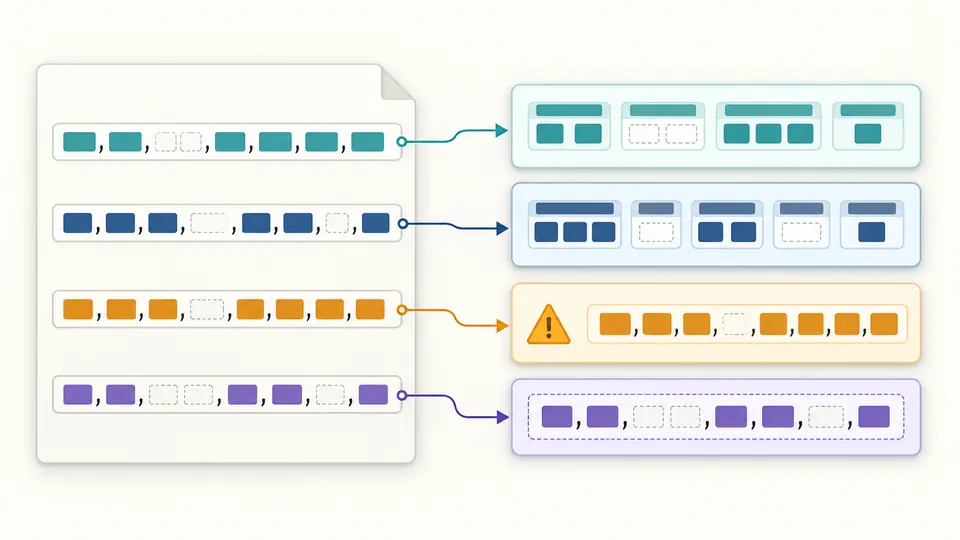
Paste one sentence per line. Blank lines are ignored without renumbering later records. GSA has twelve satellite slots; deleting empty tokens would move the DOP fields into the wrong positions.
Protocols & Binary Serialization
Paste a captured log to inspect each sentence, including unknown layouts and damaged lines.
Enter a log or try the example.
Your log is processed in this browser, without uploading or storing it.
Named fields: GGA, RMC, GLL, GSA, GSV, VTG and ZDA.
Decoded coordinates are numerical values, not a navigation approval. Inspect checksum and fix diagnostics.
Enter a log or try the example.
Use this NMEA parser when a receiver log looks plausible but the application reads the wrong position, drops a line or loses satellite fields. The report keeps the original tokens beside their meaning, so an empty slot never silently turns into zero.
The NMEA parser returns a record for each non-empty physical line. Recognized sentences, unknown vendor messages and malformed text remain in the same report, with their original line numbers for comparison with the capture.
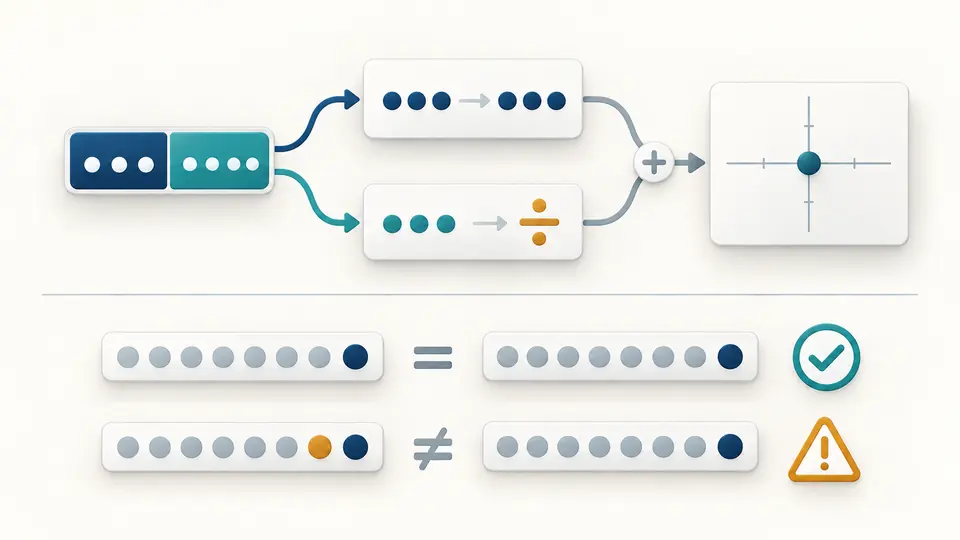
A converted latitude does not certify a fix. Read the independent checksum result and receiver diagnostics alongside the numeric conversion; a bad checksum remains visible even when the fields can be read.
Paste one sentence per line. Blank lines are ignored without renumbering later records. GSA has twelve satellite slots; deleting empty tokens would move the DOP fields into the wrong positions.
Checksum inspection always runs. A missing suffix means unverified integrity; a mismatch includes both received and calculated values. The parser never rewrites the suffix to make a damaged sentence pass.
Automatic parsing waits 350 ms after an edit. Turn it off to use Parse or Ctrl/Cmd + Enter. Old results cannot be copied until refreshed; the JSON download includes every record, beyond the first 50 shown.
GGA, RMC and GLL cover position fields; GSA retains satellite slots and DOP; GSV lists per-message satellite groups; VTG exposes course and speed; ZDA carries a full date.
The NMEA sentence decoder computes XOR over the printable ASCII payload between the start marker and asterisk. Missing, malformed and mismatching suffixes have distinct states, independent of supported sentence type.
Latitude uses ddmm and longitude dddmm, followed by optional decimal minutes. Conversion applies S/W signs, checks minute and degree bounds, and preserves fractional UTC seconds, including a valid leap second.
This GPS log parser preserves station and satellite identifiers with leading zeros. Optional mode, navigation status, system and signal fields keep their positions; extra fields are retained without invented names or meanings.
Split off the final two digits before the decimal point as minutes, then add minutes divided by 60 to the degrees. S and W make the value negative. The raw field remains visible for checking the conversion.
GP is the talker identifier and GGA is the position-data layout. GN can indicate combined satellite systems. The decoder selects the layout by the last three letters of a standard address and preserves the actual talker.
The NMEA checksum is an XOR of payload character codes, including commas but excluding the start marker and asterisk. Compare the calculated two-digit hexadecimal value with the suffix; a match cannot prove position accuracy.
GGA, RMC, GLL, GSA, GSV, VTG and ZDA have named fields. Other types, including proprietary sentences, still appear in the report with their address and numbered original fields when the envelope can be split.
GGA and GLL provide a UTC time without a date. This tool deliberately keeps that distinction. RMC exposes its two-digit year without a century guess; ZDA can supply an explicit four-digit calendar date.
Did a field surprise you?
Return to the NMEA parser with the next capture. Compare a reported problem against the numbered original fields before changing receiver settings.