01
Start with explicit components
The default component mode gives every field a value. Use * for any value; clearing a field requires an empty component. The base resolves candidate URLs here and does not silently supply host restrictions.
URLS & ROUTING
Test one pattern against a URL on each line. Choose URLPattern or the path-only route adapter below.
URLs and patterns are processed in this browser. Entered URLs are never requested.
Enter at least one candidate URL.
URLPattern: * matches any value; an empty field matches an empty component. Details show independent component captures, even if the whole URL misses.
Base URL resolves relative candidates and relative string patterns. It does not constrain component-mode patterns.
Limits: 512 units per pattern/component, 200 URLs, 2,048 per URL/base, 131,072 total UTF-16 units; 2-second worker budget.
Results are outdated or being calculated.
A route looks correct until a different host, encoded parameter or trailing slash changes the result. This URL pattern tester keeps successful and failing cases together, so changing one component gives you evidence about the actual boundary.
Use the URLPattern API tester for whole addresses and the route pattern tester for pathname rules. Both run the selected dependency directly. A URL route matcher cannot tell you whether an endpoint exists or which handler a server will choose.
The URL pattern tester separates an overall match from eight independent component diagnostics. A host can fail while the pathname still captures an id. That partial capture remains diagnostic evidence; it is not reported as a successful whole-URL exec result.
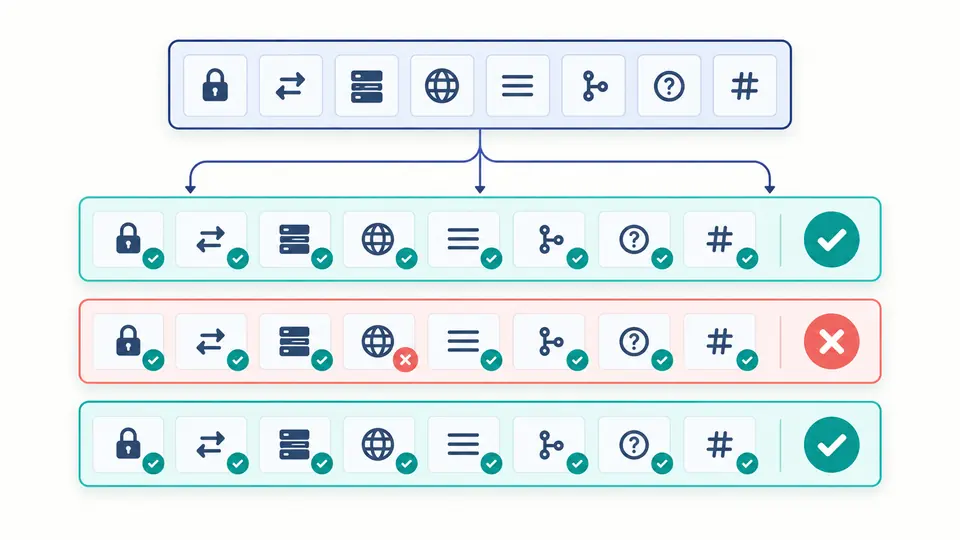
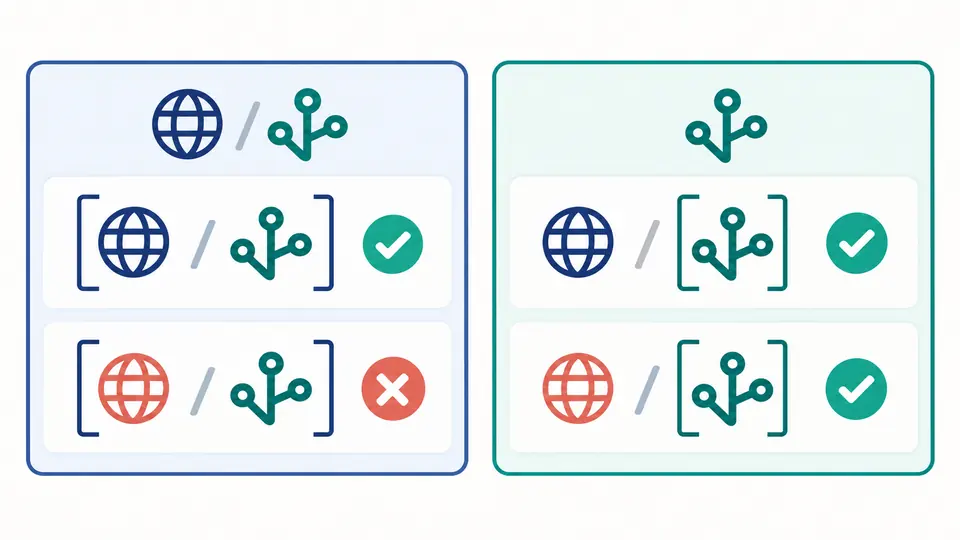
A URLPattern hostname restriction excludes another origin. The route adapter reads only pathname, so the same path on that origin can match. Keeping both cases makes the engine choice visible before a pattern reaches an application.
The default component mode gives every field a value. Use * for any value; clearing a field requires an empty component. The base resolves candidate URLs here and does not silently supply host restrictions.
Select path-to-regexp v8 for Express 5 path syntax. It exposes end, trailing and parameter decoding separately. A mode switch preserves your stored pattern and component inputs; it does not translate between grammars.
Automatic testing waits 350 ms after edits. Disable it to use the button or Ctrl/Cmd + Enter. Editing immediately disables old exports. Expand component details on a miss, then copy the report when testing finishes.
The URL pattern tester uses urlpattern-polyfill 10.1.0 and path-to-regexp 8.4.2. The report records engine, version, inputs and options. All browsers use the pinned polyfill, so this is not a probe of the browser’s native URLPattern implementation.
URLPattern groups stay grouped by URL component and preserve encoded values. Optional captures are exported as null. The route engine normally decodes parameters; named wildcards return arrays, while disabling decoding preserves their raw strings.
Relative candidates use the explicit base URL. Results show the original input beside its normalized address when they differ, including default-port removal and dot-segment resolution. Changing the base can change a candidate before any matching happens.
Invalid URLs and parameter decoding errors retain their original line numbers, while valid rows continue. Pattern compilation errors stop the run. Results appear 50 at a time; JSON export includes every row, including errors and negative cases.
Yes. The search component is a sequence, so a=1&b=2 and b=2&a=1 are different strings. Use a pattern that describes the order you expect; this tool does not turn the query into an unordered parameter map.
The tool starts with ignoreCase off. Enable it to change path and other pattern comparisons. Hostnames are already canonicalized by URL parsing, so an uppercase hostname alone is not a useful test of case-sensitive pathname matching.
A URL such as https://example.com:443/users/42 is normalized with an empty port. A required named port group cannot capture 443 from that empty component. Inspect the normalized address and the effective port pattern.
URLPattern checks eight URL components and uses its own standard grammar. The v8 adapter checks pathname only, uses braces for optional segments and requires names after wildcard stars. Selecting it does not simulate an Express request or application configuration.
URLPattern does not add an optional slash to a literal pathname. For example, /users/:id does not match /users/42/. The route adapter allows a trailing delimiter by default; switch that option off to require a stricter ending.
Have an unexpected route case?
Keep a URL you expect to match beside one you expect to fail. Change one constraint and inspect both rows before saving the report.