01
Choose a version first
Use the UUID v4 generator for fresh random values or the UUID v5 generator for a stable name mapping. v3/v5 always return one ID.
- An empty name is valid; multiple lines are one name.
Identifiers
Choose a version; random batches run only when you explicitly generate them.
Input is processed in this browser and is not sent to a server.
Random/time batch: 1–1,000. Name: up to 100,000 UTF-16 code units, one UUID. v1/v6: at most 10,000 ticks per millisecond; v7 has no same-millisecond ordering guarantee.
Choose settings, then generate.
Use the UUID generator to prepare fixture IDs, populate an import or derive the same identifier from an agreed name. Choose the identity rule before choosing how the text looks.
The default is one lowercase v4 with hyphens. Name-based versions instead produce one result from a namespace and the exact UTF-8 name, including spaces and line breaks.
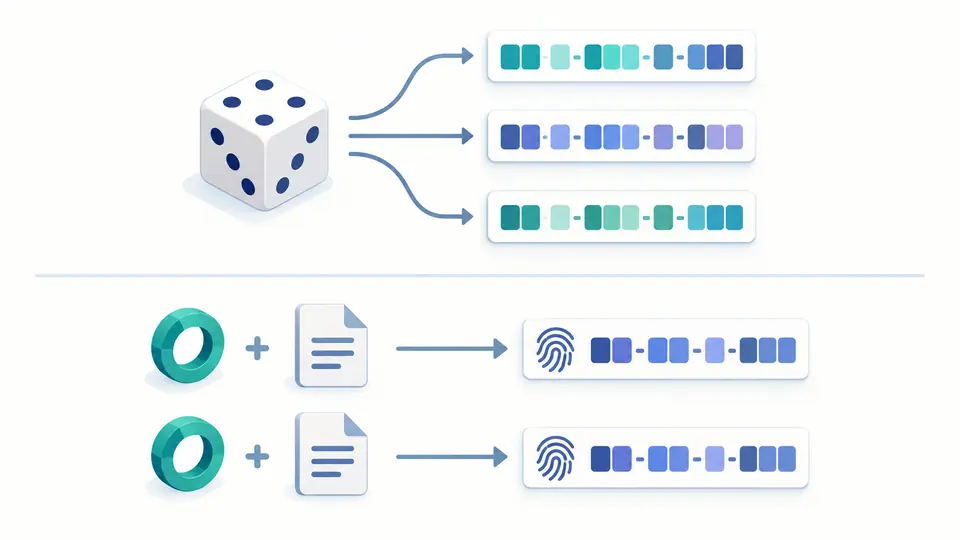
The UUID generator separates fresh random IDs from deterministic v3/v5 results. Repeating a namespace and name reproduces an ID; pressing Generate in a random mode requests a new batch.
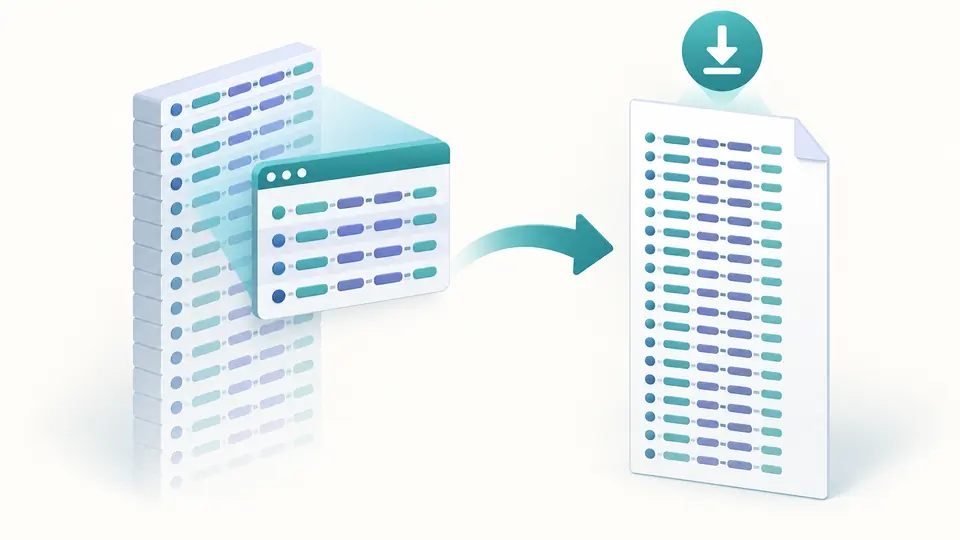
The preview starts with 50 rows and expands by 100. TXT contains one ID per line; the JSON report includes all results and, for name-based generation, the original name and namespace.
Use the UUID v4 generator for fresh random values or the UUID v5 generator for a stable name mapping. v3/v5 always return one ID.
Generation is manual by default. Only v3/v5 can update automatically after 350 ms; random and time-based versions always need an explicit run.
The bulk UUID generator accepts 1–1,000 results in random and time-based modes. Copy and downloads include rows beyond the visible preview.
Create identifiers using browser cryptographic randomness. Version and variant occupy reserved bits; the remaining 122 bits are random.
Choose DNS, URL, OID, X.500 or a custom namespace UUID. v3 uses MD5; v5 uses SHA-1. Both hash the namespace bytes and name.
v1/v6 combine time with a random multicast node and clock sequence. v7 puts Unix milliseconds first, followed by 74 random bits around its reserved fields.
Uppercase and lowercase, with or without hyphens, give 36- or 32-character text for a 128-bit UUID; formatting itself does not alter its bits. This workbench requires another run after format edits, which creates fresh IDs in random modes.
The namespace is a UUID that establishes a naming domain; the name is the exact string within it. Agree on both, including normalization rules, before using the resulting ID across systems.
Yes, for identical namespace bytes and UTF-8 name bytes. A trailing space, case change or different Unicode composition can change the result. Formatting the UUID in uppercase does not change its underlying bits.
Both are deterministic and namespace-based. v3 uses MD5 while v5 uses SHA-1; choose the version required by the protocol or system you integrate with. Neither is a password-hashing method.
There is no general decoding operation that recovers the name. Someone who knows the namespace can still test likely names, so hashing a name does not make it confidential.
Use v5 when the same agreed name should map to the same ID. Use v4 for independent random IDs when you do not need that mapping. Keep uniqueness checks appropriate to your application.
Have a question about a result?
Use the UUID generator with your chosen version, inspect the new results and export the complete batch when the settings are final.