01
Choose the direction first
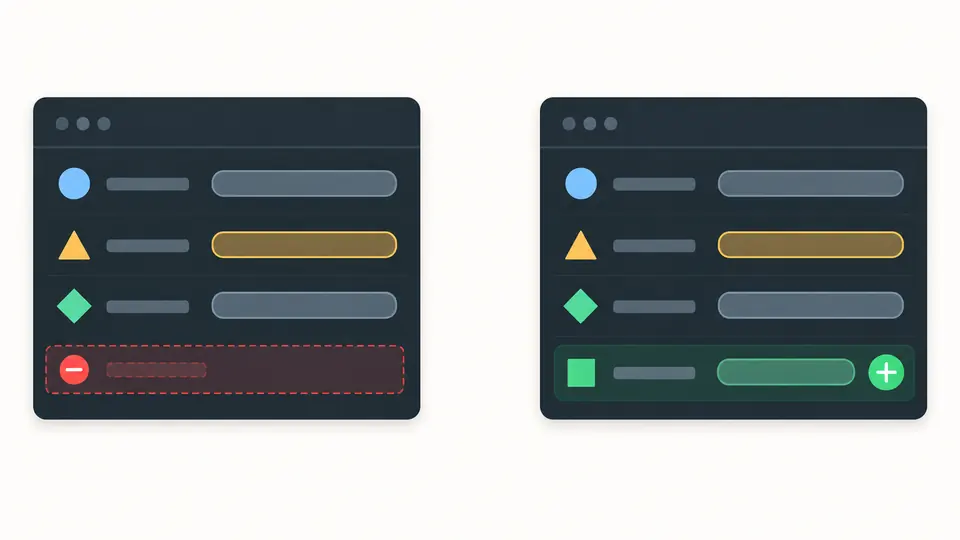
Place .env.example in A and your deployment configuration in B. “Missing in B” now means the target lacks a documented variable. Swapping the content reverses the meaning of added and missing.
Configuration checks
Put expected variables in A and the actual configuration in B. Try keys-only mode when checking an example file.
Runs in your browser. Inputs stay in memory, without URLs, telemetry or local history.
Enter at least one configuration. An empty side is allowed.
ENV diff helps investigate the configuration gap behind a deployment that works locally but fails elsewhere. Matching assignments by name removes the noise of moved lines, so a missing variable is visible even when both files use different ordering.
A baseline is a reference, not a source of correct production secrets. Review every missing key with the application requirements before filling it in; an empty assignment is present but may still be unusable.
With ENV diff, a production token can differ from a template placeholder without distracting from missing names. Enable keys-only mode for coverage checks; use full comparison when investigating an unexpected port or endpoint.
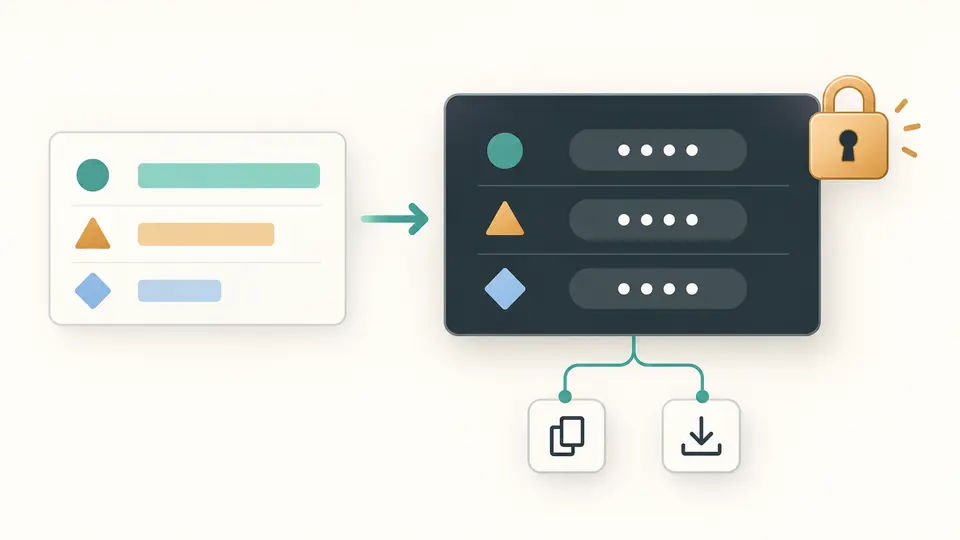
Results start with a fixed mask for every value. Copy and download use the same visibility setting, including values whose key names do not look sensitive. The original editors remain readable.
Place .env.example in A and your deployment configuration in B. “Missing in B” now means the target lacks a documented variable. Swapping the content reverses the meaning of added and missing.
Keys-only mode ignores differences between shared values entirely. For full comparison, list deliberate exceptions by exact key name; ignoring PORT does not ignore PORT_EXTRA.
Edits invalidate the report immediately. Wait for the 350 ms automatic update, or disable automatic mode and use Ctrl/Cmd + Enter. Check duplicate assignments before exporting.
ENV diff separates keys added to B, keys absent from B and changed values. Matching keys are counted without filling the result with unchanged assignments. Names use stable alphabetical order.
Compare .env files without sorting the source first. Comments, blank lines and assignment order do not create changes. An empty value counts as a defined key, which makes template checks predictable.
The .env.example comparison can exclude exact names separated by commas or new lines. The screen reveals results in batches of 100; the downloaded text contains every difference and duplicate warning.
Paste the reference into A and the target into B. Automatic mode runs after a short pause. ENV diff compares parsed keys and values, so different line ordering alone produces no differences.
Use the expected configuration as A, then inspect Missing in B. To check only whether names are present, enable keys-only mode. A variable assigned an empty string is not missing; review whether your application permits that value.
Paste the example in A and the real configuration in B, then enable keys-only comparison. Placeholder values often differ intentionally. An outdated example cannot reveal a requirement that is absent from both files.
The parser checks assignment syntax, key names, closed quotes and content after quoted values. It reports the input side and position. Duplicate assignments are warnings with the last definition selected; other syntax errors prevent export.
Result groups are sorted by key automatically. The input files are never sorted or rewritten. This preserves comments and line positions so you can locate the corresponding assignments in the original configuration.
Something wrong with the comparison?
Check names, review changes, and export the report only after its counts match what you expected.